Filter by

The Cost of Discipleship
One of the most important theologians of the twentieth century illuminates the relationship between ourselves and the teachings of Jesus. What can the call to discipleship, the adherence to the word of Jesus, mean today to the businessman, the soldier, the laborer, or the aristocrat? What did Jesus mean to say to us? What is his will for us today? Drawing on the Sermon on the Mount, Dietrich Bo…
- Edition
- -
- ISBN/ISSN
- 9780684815008
- Collation
- Softcover; 316 hlm.; 14 x 21.5 cm
- Series Title
- -
- Call Number
- R 241.53 B714 C1

Reading the Sermon on the Mount: Character Formation and Decision Making in M…
The Sermon on the Mount is one of the most familiar passages in the New Testament. In this concise and clearly-written introduction to and commentary on the Sermon, Charles Talbert pays particular attention to its role in character formation and ethical decision making. After introductory chapters on reading the Sermon on the Mount, the book offers a section-by-section commentary. Talbert point…
- Edition
- -
- ISBN/ISSN
- 9780801031632
- Collation
- Softcover, 181 hlm.; 15 x 23 cm
- Series Title
- -
- Call Number
- R 226.906 T137 C1

Christian Ethics: A Historical Introduction
This one-volume history of Christian ethics is the only comprehensive resource currently available to survey major thinkers, movements, and issues from the early church to the present. Topics discussed are: the legacies of Christian ethics, the ethics of early Christianity, the Reformation and Enlightenment, eighteenth and nineteenth-century rationalism and evangelism, Christian ethics in the t…
- Edition
- -
- ISBN/ISSN
- 9780664251635
- Collation
- Softcover; 340 hlm.; 15 x 23 cm
- Series Title
- -
- Call Number
- R 241 W845 C1
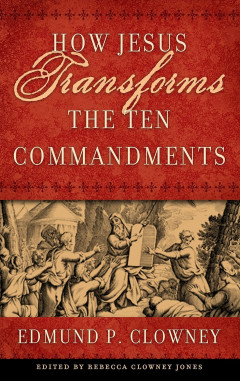
How Jesus Transforms The Ten Commandments
For many Christians, conditioned to emphasize our freedom from the law. Jesus' words seem strange, even incompatible with the gospel.of grace. If Jesus did not abolish the law, then how should we look at the Ten Commandments today? Clowney explains how Jesus intensifies the law and expands its scope to every situation in life. But as the author did so often during his ministry, he goes further,…
- Edition
- -
- ISBN/ISSN
- 9781596380363
- Collation
- Softcover; 162 hlm.; 13.97 x 21.54 cm
- Series Title
- -
- Call Number
- F 241.52 C648 C1

An Eerdmans Reader in Contemporary Political Theology
An Eerdmans Reader in Contemporary Political Theology gathers some of the most significant and influential writings in political theology from the twentieth and twenty-first centuries. Given that the locus of Christianity is undeniably shifting to the global South, this volume uniquely integrates key voices from Africa, Asia, and Latin America with central texts from Europe and North America on…
- Edition
- -
- ISBN/ISSN
- 9780802864406
- Collation
- Softcover; 812 hlm.; 15 x 23 cm
- Series Title
- -
- Call Number
- F 261.7 C377 C1
 Computer Science, Information & General Works
  Philosophy & Psychology
  Religion
  Social Sciences
  Language
  Pure Science
  Applied Sciences
  Art & Recreation
  Literature
  History & Geography