Filter by

Revelation and Reason: New Essays in Reformed Apologetics
This collection of essays sets in the foreground the necessity of exegetical and theological foundations for any Reformed, Christian apologetic. A Reformed apologetic is only Reformed to the extent that its tenets, principles, and methodology are formed and re-formed by Scripture. Here, noted theologians show the necessity of the truth of Scripture and the implications of that truth for apologe…
- Edition
- -
- ISBN/ISSN
- 9780875525969
- Collation
- Softcover, 336 hlm, 15x23cm
- Series Title
- -
- Call Number
- F 239 O47 C1
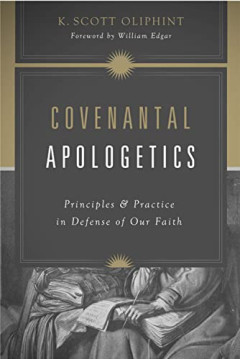
Covenantal Apologetics: Principles and Practice in Defense of Our Faith
Defending the faith can be daunting, and a well-reasoned and biblically grounded apologetic is essential for the challenge. Following in the footsteps of groundbreaking apologist Cornelius Van Til, Scott Oliphint presents us with an introduction to Reformed apologetics as he sets forth the principles behind a distinctly ?covenantal? approach. This book clearly explains the theological foundatio…
- Edition
- -
- ISBN/ISSN
- 9781433528170
- Collation
- Softcover; 277 hlm.; 15 x 23 cm
- Series Title
- -
- Call Number
- R 239 O47 C1
Should You Believe in God?
People increasingly demonstrate a disbelief in God. In a conversational style, apologist Scott Oliphint discusses why belief is still a preferable and more coherent position than unbelief and answers common objections to Christian belief. "Should You Believe in God? by Scott Oliphint is a very capable and winsome statement of Christian theism. I commend it to you."--Douglas Wilson, Christ Ch…
- Edition
- 1
- ISBN/ISSN
- 9781596386778
- Collation
- Softcover; 32 hlm.; 13.46 x 20.57 cm
- Series Title
- Christian Answers to Hard Questions
- Call Number
- F 239 O47 C1
Christianity and the Role of Philosophy
A philosophy, as a worldview, must have an anchor if it is to be meaningfully discussed and assessed. If God exists, then philosophy must find its anchor by being subservient to theology. So says Dr. K. Scott Oliphint, who demonstrates that only by beginning with God and his Word can we engage in true philosophy.
- Edition
- -
- ISBN/ISSN
- 9781596386747
- Collation
- Softcover; 36 hlm.; 14 x 21.5 cm
- Series Title
- Christian Answers to Hard Questions
- Call Number
- F 261.5 O47 C1

A Christian Worldview: Essays from a Reformed Perspective (Willborn)
The essays in this volume address some Worldview matters related to certain extremely germane topics Christian Face every day of their life. While they are of a more popular tenor, and are not highly technical or necessarily philosophical, they do speak seriously and ably to serious issues of our day. Some of the topics will not surprise you. The near ubiquitous issues of informational technolo…
- Edition
- -
- ISBN/ISSN
- 9781931639125
- Collation
- Softcover; 168 hlm.; 15 x 23 cm
- Series Title
- -
- Call Number
- F 239 O47 C1

Jesus is Both God and Man: What the Bible Teaches About the Person of Christ
Read this book and recover a sense of wonder as you are drawn to gaze upon the person of the Lord Jesus Christ. Perhaps you have wondered how two natures could perfectly co-exist in one the answers are here, clearly drawn from Scripture and expressed in plain English. It also exposes the fundamental errors of the cults and the liberal theologians who either deny our Lord's divinity or do not do…
- Edition
- -
- ISBN/ISSN
- 9780852344316
- Collation
- Softcover; 175 hlm.; 13.5 x 21.5 cm
- Series Title
- -
- Call Number
- F 232.8 O53 C1

Berpola Pikir Rohani
"~Kita Seringkali beranggapan bahwa anugerah Tuhan bagi kita anak-anakNya, semata-mata hanyalah kehidupan kekal. Padahal faktanya tidaklah demikian. John Owen menulis: "" Selain menjanjikan pengampunan dosa bagi orang percaya, Injil juga menjanjikan damai sejahtera, sukacita, kekuatan rohani, jaminan, dan pengharapan. Akan tetapi, banyak orang Kristen yang dalam kehidupan rohaninya hanya memper…
- Edition
- -
- ISBN/ISSN
- 9789798307515
- Collation
- Soft Cover, 67 hlm, 11 x 17,5 cm
- Series Title
- -
- Call Number
- F 248 O974 C1

Knowing God
This edition is updated with Americanized language and spelling and a new preface by the author. Stemming from Packer's profound theological knowledge, Knowing God brings together two important facets of the Christian faith― knowing about God and also knowing God through the context of a close relationship with the person of Jesus Christ. Written in an engaging and practical tone, this though…
- Edition
- -
- ISBN/ISSN
- 9780830816507
- Collation
- Softcover; 286 hlm.; 14 x 20.8 cm
- Series Title
- -
- Call Number
- F 231 P119 C1

Affirming the Apostles' Creed
The Apostles Creed is the oldest, most beautiful succinct summary of Christian beliefs. Though often recited in unison during worship services, the creed begins with the phrase "I believe," making it a deeply personal profession of faith. But when was the last time you examined it closely? In Affirming the Apostles' Creed, an excerpt from Growing in Christ, noted Bible scholar and author J. …
- Edition
- -
- ISBN/ISSN
- 9781433502101
- Collation
- Softcover; 155 hlm.; 12.3 x 17.7 cm
- Series Title
- -
- Call Number
- F 238.11 P119 C1

A Quest for Godliness: The Puritan Vision of the Christian Life
J. I. Packer has had a long-standing passion for the Puritans. Their understanding of God and His ways with man has largely formed his own spirituality and theological outlook. In A Quest for Godliness, the esteemed author of Knowing God and a dozen other books shares with his readers the rich world of Puritanism that has been so influential in his own life. Dr. Packer masterfully uncovers the …
- Edition
- -
- ISBN/ISSN
- 9780891078197
- Collation
- Softcover; 367 hlm.; 15 x 23 cm
- Series Title
- -
- Call Number
- F 285.9 P119 C1
 Computer Science, Information & General Works
  Philosophy & Psychology
  Religion
  Social Sciences
  Language
  Pure Science
  Applied Sciences
  Art & Recreation
  Literature
  History & Geography