Filter by

John Sung My Teacher
The story of John Sung is simply the story of Holy Spirit Revival, not of the spurious ecumenical sort currently infecting churches around the world. John Sung unequivocally rebuked the tongue speakers, the liberals, modernists, apostates and ecumenist of this day. Were he alive today, he would not spare these false prophets the reproof of God's Word.
- Edition
- 1
- ISBN/ISSN
- 9971991136
- Collation
- Softcover; 288 hlm.; 13.3 x 20.9 cm
- Series Title
- -
- Call Number
- F 275.1 T737 C1

Minority Report: Unpopular Thoughts on Everything from Ancient Christianity t…
Theological essays are dusty, humourless affairs aren't they? Well, they don't have to be! This is the second collection of essays by Carl Trueman. His first collection was received with the enthusiasm. This time Chick Lit, Adolf Eichman, the i-pod, Roger Beckwith, the Blues, Watership Down, American Idol, Nietzsche, zen-calvinism, Augustine and ferrets(!) all get a mention. If you want to info…
- Edition
- -
- ISBN/ISSN
- 9781845503178
- Collation
- Softcover; 221 hlm.; 13 x 21.5 cm
- Series Title
- -
- Call Number
- F 230 T866 C1

The Real Scandal of Evangelical Mind
What is an evangelical . . . and has he lost his mind? Carl Trueman wrestles with those two provocative questions and concludes that modern evangelicals emphasize experience and activism at the expense of theology. Their minds go fuzzy as they downplay doctrine. The result is "a world in which everyone from Joel Osteen to Brian McLaren to John MacArthur may be called an evangelical." Fifteen…
- Edition
- -
- ISBN/ISSN
- 9780802478153
- Collation
- Softcover; 41 hlm.; 13.97 x 21.59 cm
- Series Title
- -
- Call Number
- F 280.40973 T866 C1
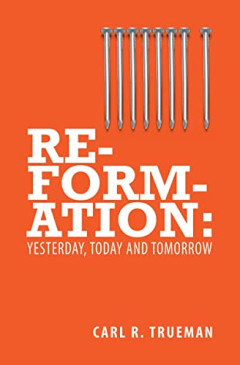
Reformation: Yesterday, Today, and Tomorrow
- Edition
- 1
- ISBN/ISSN
- 9781845507015
- Collation
- Softcover; 128 hlm.; 12.7 x 19.3 cm
- Series Title
- -
- Call Number
- F 270 T866 C1
- Edition
- 1
- ISBN/ISSN
- 9781845507015
- Collation
- Softcover; 128 hlm.; 12.7 x 19.3 cm
- Series Title
- -
- Call Number
- F 270 T866 C1

The Creedal Imperative
What if “No creed but the Bible” is unbiblical? The role of confessions and creeds is the subject of debate within evangelicalism today as many resonate with the call to return to Christianity’s ancient roots. Advocating for a balanced perspective, Carl Trueman offers an analysis of why creeds and confessions are necessary, how they have developed over time, and how they can function i…
- Edition
- 1
- ISBN/ISSN
- 9781433521904 / 1433521903
- Collation
- Softcover; 208 hlm.; 13.97 x 21.59 cm
- Series Title
- -
- Call Number
- F 238 T866 C1

Gods of This Age or...GOD of The Ages?
- Edition
- 1
- ISBN/ISSN
- 0-8054-1548-3
- Collation
- -
- Series Title
- -
- Call Number
- F 270.829 C1
- Edition
- 1
- ISBN/ISSN
- 0-8054-1548-3
- Collation
- -
- Series Title
- -
- Call Number
- F 270.829 C1
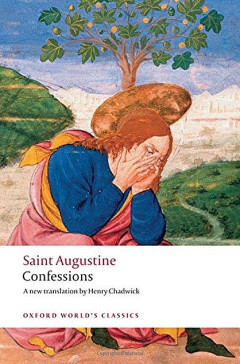
Saint Agustine: Confessions
In his own day the dominant personality of the Western Church, Augustine of Hippo today stands as perhaps the greatest thinker of Christian antiquity, and his "Confessions" is one of the great works of Western literature. In this intensely personal narrative, Augustine relates his rare ascent from a humble Algerian farm to the edge of the corridors of power at the imperial court in Milan, his s…
- Edition
- 3
- ISBN/ISSN
- 9780199537822
- Collation
- Softcover; 352 hlm.; 13.03 x 19.89 cm
- Series Title
- Oxford World's Classics
- Call Number
- F 270.2092 A9236 C1

Institutes of the Christian Religion
Theologian par excellence of the Reformation, John Calvin is best known for his Institutes of the Christian Religion, written as a theological introduction to the Bible and a vindication of Reformation principles. After appearing in several editions beginning in 1536, Calvin's Institutes was finally published in this authoritative 1559 edition. Henry Beveridge's translation of Calvin's magnum o…
- Edition
- -
- ISBN/ISSN
- 9780802881663
- Collation
- Softcover; 704 hlm.; 15.44 x 22.91 cm
- Series Title
- -
- Call Number
- F 230.4 C168 C1
Halley's Bible Handbook
- Edition
- -
- ISBN/ISSN
- 03110257204
- Collation
- 860hlm, 12,5x18,5 cm
- Series Title
- -
- Call Number
- R 220.7 H187 C1
- Edition
- -
- ISBN/ISSN
- 03110257204
- Collation
- 860hlm, 12,5x18,5 cm
- Series Title
- -
- Call Number
- R 220.7 H187 C1
The New Hermeneutic
In earlier publications the present writer pointed out that the synthesis between a theology based on that of the Ref'ormcrs and a theology based on the philosophy of Kant is an intellectual and spiritual monstrosity. In it Kant, not Calvin is the real victor. The result is the destruction of an intelligible basis for human predication. What is needed is a really Reformational philosophy and th…
- Edition
- -
- ISBN/ISSN
- -
- Collation
- Softcover; 230 hlm.; 14 x 21 cm
- Series Title
- -
- Call Number
- F 220.601 V282 C1
 Computer Science, Information & General Works
  Philosophy & Psychology
  Religion
  Social Sciences
  Language
  Pure Science
  Applied Sciences
  Art & Recreation
  Literature
  History & Geography