Filter by

Soul Searching: Chinese Intellectuals on Faith and Society (Horizon)
"~What appeared to be a failed revolution at Tian'anmen became the springboard for an unprecedented work of God in the hearts of Chinese intellectuals. Soul Searching represents the firstfruits of this spiritual revolution among former democracy activists who are finding, in the words of Wang Ce, ""the pearl inside the shell"".~"
- Edition
- -
- ISBN/ISSN
- 1895980399
- Collation
- Softcover, 110 hlm, 14x21.5cm
- Series Title
- -
- Call Number
- F 275.1 L755 C1
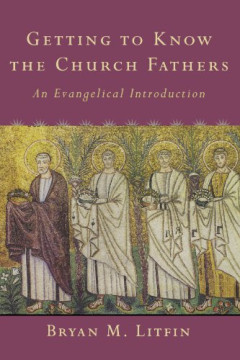
Getting To Know The Church Fathers: An Evangelical Introduction
Augustine. Tertullian. Origen. For too many Christians such names are abstract, one-dimensional legends, innocuous voices from antiquity no longer relevant to modern needs and concerns. However, a closer look at these church fathers reveals writers whose reflections on the apostolic teachings edify all generations of believers. Bryan Liftin helps readers understand the fathers as individuals wh…
- Edition
- -
- ISBN/ISSN
- 978-1-58743-196-8
- Collation
- 301 hlm.; Soft Cover 15 x 23 cm
- Series Title
- -
- Call Number
- R 270.1 L776 C1

Lest We Build on Sand
A study of the natural basis for supernatural formation. As the sub-title indicates, this is a study of the natural basis for supernatural formation. It stresses the fact that today we live in a culture in transition, that supernatural living rests upon a natural basis, and that modern formation of religious must take into account the personality, attitudes, psychological needs and self-concept…
- Edition
- -
- ISBN/ISSN
- -
- Collation
- Hardcover, 292 hlm, 14.5x22.5 cm
- Series Title
- -
- Call Number
- F 271.069 M2147 C1
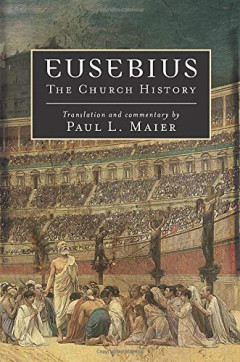
Eusebius: The Church History
Often called the "Father of Church History," Eusebius was the first to trace the rise of Christianity during its crucial first three centuries from Christ to Constantine. Our principal resource for earliest Christianity, The Church History presents a panorama of apostles, church fathers, emperors, bishops, heroes, heretics, confessors, and martyrs. This paperback edition includes Paul L. Maier'…
- Edition
- -
- ISBN/ISSN
- 9780825433078
- Collation
- Softcover; 368 hlm.; 13 x 20 cm
- Series Title
- -
- Call Number
- F 270.1 M217 C1

Like a Mighty River
- Edition
- 1
- ISBN/ISSN
- 9780932260024
- Collation
- Hardcover; 220 hlm.; 14.3 x 21.4 cm
- Series Title
- -
- Call Number
- F 270.82 M294 C1
- Edition
- 1
- ISBN/ISSN
- 9780932260024
- Collation
- Hardcover; 220 hlm.; 14.3 x 21.4 cm
- Series Title
- -
- Call Number
- F 270.82 M294 C1

The Intellectual Origins Of The European Reformation
It is widely recognized that the sixteenth-century Reformation remains are of the most fascinating and exiting areas of scholarship. A central and important question, raised by intensive modern research on the Renaissance and late medieval scholasticism, concerns the intellectual origins of the Reformation. This updated and expanded version of the original, highly acclaimed edition of 1987 expl…
- Edition
- 2
- ISBN/ISSN
- 978-0-631-22939-1
- Collation
- 299 hlm, Soft Cover 15 x 22,5 cm
- Series Title
- -
- Call Number
- F 274.06 M147 C1
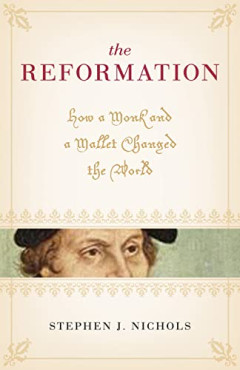
The Reformation: How a Monk and a Mallet Changed the World
Mention history and some might struggle to stifle a yawn. But when presented as a narrative it can often be compelling reading. Stephen J. Nichols takes a key period in time, the Reformation, and presents its major players in a fresh way. From Martin Luther, a simple monk who wielded the mallet, to kings and queens, this book goes behind the scenes to uncover the human side of these larger-than…
- Edition
- -
- ISBN/ISSN
- 9781581348293
- Collation
- Softcover; 159 hlm.; 14 x 21.5 cm
- Series Title
- -
- Call Number
- F 270.6 N622 C1
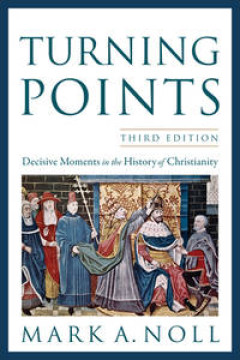
Turning Points: Decisive Moments in the History of Christianity
This bestselling textbook (over 125,000 copies sold) isolates key events that provide a framework for understanding the history of Christianity. The book presents Christianity as a worldwide phenomenon rather than just a Western experience. This popular textbook is organized around 14 key moments in church history, providing contemporary Christians with a fuller understanding of God as he ha…
- Edition
- 3
- ISBN/ISSN
- 9780801039966
- Collation
- Softcover; 368 hlm.; 15.24 x 22.86 cm
- Series Title
- -
- Call Number
- R 270.00 N793 C1
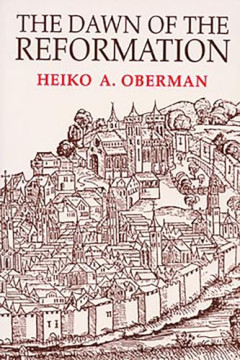
The Dawn of the Reformation: Essays in Late Medieval and Early Reformation Th…
Throughout these essays there runs a common theme: the need to place the Reformation movement in its medieval context, and to bridge the ideological gaps between late medieval Renaissance, and Reformation studies. The opening chapters consider late medieval thought and the emergence of the young Luther at the center of the Reformation movement. There follows a study of the impact upon Luther of…
- Edition
- 1
- ISBN/ISSN
- 0576292045
- Collation
- Softcover; 309 hlm.; 15 x 23 cm
- Series Title
- -
- Call Number
- F 270.6 O125 C1

Changing Contexts of Our Faith
- Edition
- -
- ISBN/ISSN
- 0-8006-1862-9
- Collation
- Soft Cover, 111 hlm, 21.6x14cm
- Series Title
- -
- Call Number
- F 277.3 R959 C1
- Edition
- -
- ISBN/ISSN
- 0-8006-1862-9
- Collation
- Soft Cover, 111 hlm, 21.6x14cm
- Series Title
- -
- Call Number
- F 277.3 R959 C1
 Computer Science, Information & General Works
  Philosophy & Psychology
  Religion
  Social Sciences
  Language
  Pure Science
  Applied Sciences
  Art & Recreation
  Literature
  History & Geography